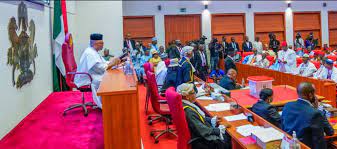
House of Reps Publishes Certified True Copies of Four Tax Reform Acts
The Nigerian House of Representatives has released certified true copies (CTCs) of four tax reform Acts passed by the National Assembly and signed into law by President Bola Tinubu. The move aims to address concerns that some circulating versions were altered and to promote transparency, accuracy, and trust in the legislative record.
Speaker Abbas Tajudeen directed the release of the CTCs, stressing that the National Assembly keeps official records with strict verification and archival procedures to ensure authenticity.
Spokesperson Akintunde Rotimi announced that the original law, as passed and signed by the President is now public, and hard copies have been distributed to members.
The release is intended to counter reports of inconsistent or unauthorised versions and to strengthen public confidence in the law-making process.
The leadership reaffirmed a commitment to transparency, integrity, and adherence to constitutional and parliamentary procedure throughout the tax reform process.
What the four Acts are
- Nigeria Tax Act, 2025
- Nigeria Tax Administration Act, 2025
- National Revenue Service (Establishment) Act, 2025
- Joint Revenue Board (Establishment) Act, 2025
Purpose and aims
These Acts form the backbone of Nigeria’s tax reform framework, aiming to modernise revenue administration, improve compliance, reduce inefficiencies, eliminate duplications, and strengthen fiscal coordination nationwide.
The National Assembly says the only authentic versions are the certified Acts released by the National Assembly.
Members of the public and stakeholders are urged to disregard any other documents not certified by the National Assembly.
The Clerk to the National Assembly has coordinated with the Federal Government Printing Press to ensure accuracy and uniformity.
Hard copies have been prepared for distribution to members, senators, and the public.
An Ad-Hoc Committee, chaired by Hon. Muktar Aliyu Betara, is continuing to investigate the circumstances around any unauthorised circulation and to prevent a recurrence.
The House remains committed to constitutionalism, the rule of law, transparency, and accountable governance, and will strengthen internal controls to protect the integrity of Nigeria’s legislative process.
The new tax regime reshapes how federation revenues are shared among states and local governments.
Pay As You Earn (PAYE) and Personal Income Tax will go entirely to the states.
90% of VAT will go to subnational levels (55% to states, 35% to local governments); the Federal Capital Territory is not allocated a direct share in this arrangement.
Distributions of Company Income Tax and Petroleum Profit Tax are outlined across states and local governments with specified shares.
The changes are expected to boost subnational finances, following earlier revenue gains after fuel subsidy removal.
Technical teams will start reconfiguring sharing templates to reflect new tax accruals once activities resume after the holidays.
The Act also introduces stricter compliance measures and penalties for tax offences, with enforcement powers for tax authorities, including potential penalties, distraint, and, in serious cases, revocation of licenses. Provisions for administrative settlements (compounding) are included where appropriate, while preserving prosecutorial options.