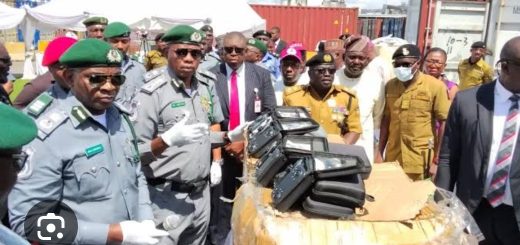
Idiroko Customs Seized Goods Worth Over ₦3.5 Billion in Two Months
The war against smuggling along the Nigeria–Benin border is taking a new turn. Under Deputy Comptroller Olukayode Oladapo Afeni, head of the Ogun I Area Command of the Nigeria Customs Service in Idiroko, enforcement has grown tougher — and the results are showing.
Between June 24 and August 13, 2026, the command intercepted prohibited goods worth ₦3.574 billion. The haul included cannabis, foreign rice, petroleum products, clothing, fertiliser, footwear, fire extinguishers and even new purses.
The biggest single item was 6,035 parcels of Ghana Loud/Indica cannabis, which has been handed over to the National Drug Law Enforcement Agency (NDLEA). Since January, the command says it has passed on 32,412 parcels of hard drugs and 92 sacks of raw Cannabis Sativa to the agency.
This shows that smuggling through the Ogun border is no longer just about cheap goods. It has become a question of national security.
A Busy Year for Seizures
The August figure did not come out of nowhere. Between April 1 and June 23, the command recorded 146 seizures worth ₦4.63 billion. In that same period it raised ₦259.8 million in revenue — a 238% jump from the ₦76.8 million collected the year before.
That revenue growth matters, because Afeni’s approach is not only about catching smugglers. It also aims to keep trade moving while raising money for the government.
Earlier, between February and March, the command seized goods worth about ₦1.35 billion, including vegetable oil, spaghetti, foreign rice, cannabis and fuel. Four live pangolins and two antique artefacts from the 19th century were also found.
Why Rice Keeps Coming Up
Foreign rice is one of the most common items in the seizure records. In the latest operation alone, officers took 2,339 bags plus 70 cartons of basmati rice.
Afeni’s argument is simple: smuggled rice undercuts local farmers and rice mills. If the government wants Nigerians to invest in farming and local food processing, the border is where that policy has to be defended.
Danger on the Border
Not every operation goes smoothly. In June, a truck carrying 113 bags of foreign rice ignored officers’ orders to stop and tried to ram a patrol vehicle before being caught. In another case, 630 bags of rice were intercepted along the Afamin–Igbogila route.
These incidents show that the stakes are high, and the command has responded by leaning more on intelligence, technology and cooperation with other security agencies rather than just patrols.
More Than Just Seizures
This is a defining quality of the command’s strategy: for every illegal item seized, officials work to increase legal shipments. Between April and June, Ogun I helped move 20,972 metric tonnes of exports worth ₦1.049 billion — a big jump, since almost no exports were recorded at the same time in 2025.
By August, the figure had grown to 10,110 metric tonnes of exports valued at ₦2.594 billion, including white talc, thermal coal and CNG.
Afeni’s goal is to make the border a filter: block the illegal, speed up the legitimate. The four pillars of his approach are enforcement, revenue, security and trade, and they are linked — a secure border supports legal commerce, which brings in revenue and strengthens government.
Still Work to Do
Yet the fight is far from over. The fact that large seizures keep happening means the smuggling economy is still active.
Real success will be measured not by how many bags of rice are seized, but by whether Nigerian farmers, manufacturers and traders can finally compete fairly and lawfully — and whether Idiroko can turn from a corridor of illicit commerce into a genuine gateway for Nigerian exports.
By that standard, the work at Ogun I is still being written. For smugglers, the message from Idiroko is clear: the routes are watched, the networks are being pursued. For legitimate business, the border is slowly becoming a safer, simpler place to do trade.