NNMJ Calls for Four-Day Cargo Dwell Time, 30% Rail Evacuation to Improve Port Efficiency
Network urges FG to fully implement National Single Window, strengthen indigenous shipping capacity and enforce maritime laws.
The Network of Nigeria Maritime Journalists (NNMJ) has called on the Federal Government to introduce urgent reforms in the country’s port operations, including reducing cargo dwell time to four days, improving vessel turnaround time and increasing rail transportation to account for between 25 and 30 per cent of cargo evacuation.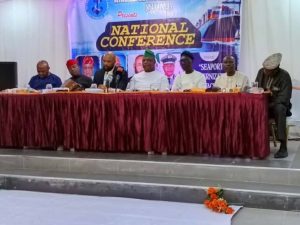
The Network also called for the full implementation of the National Single Window project, stronger indigenous shipping capacity and stricter enforcement of existing maritime laws to improve trade facilitation, curb revenue leakages and enhance the competitiveness of Nigerian ports.
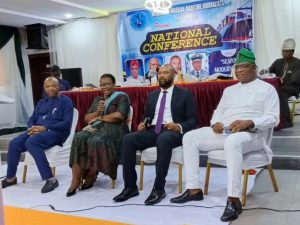
These recommendations were contained in the communiqué issued at the end of the 2026 NNMJ National Conference, held on Friday, November 13, at the Airport Hotel, Ikeja, Lagos. The conference had the theme, “Seaport Modernisation, Trade Facilitation and Revenue.”
The conference, chaired by former Director-General of the Nigerian Maritime Administration and Safety Agency (NIMASA), Barrister Temisan Omatseye, brought together major stakeholders in the maritime industry, including regulators, port operators, shipping companies, freight forwarders, maritime professionals and journalists.
In its communiqué, NNMJ maintained that Nigeria’s ambition of building a $1 trillion economy by 2030 would remain difficult to achieve without significant improvements in port infrastructure, cargo-handling capacity, transportation networks and regulatory efficiency.
Delivering the keynote address, maritime lawyer and Senior Advocate of Nigeria, Dr Emeka Akabogu, said Nigeria’s existing seaport infrastructure and operational capacity were inadequate to support the country’s economic target without substantial investment and modernisation.
Drawing from data provided by the Nigerian Ports Authority (NPA), the United Nations Conference on Trade and Development (UNCTAD) and the World Bank, Akabogu highlighted the gap between Nigeria’s current port performance and the capacity required to support a $1 trillion economy.
He explained that achieving the target would require significant growth in container traffic, cargo throughput, ship calls, vessel capacity and non-oil exports.
Akabogu identified prolonged cargo dwell time, vessel turnaround delays and inefficient cargo evacuation as major challenges affecting the performance and competitiveness of Nigerian ports.
He recommended reducing cargo dwell time to approximately four days and vessel turnaround time to about 3.3 days, noting that unnecessary delays increase shipping costs and discourage trade.
Rail transportation, National Single Window take centre stage
The conference expressed concern over Nigeria’s heavy dependence on road transportation for cargo evacuation, observing that approximately 90 per cent of cargo leaving the country’s ports is transported by road.
To address the challenge, NNMJ recommended that rail transportation should progressively handle between 25 and 30 per cent of port cargo evacuation.
According to the Network, increased rail participation would reduce road congestion, lower logistics costs and improve the movement of goods from the ports to the hinterlands.
The conference also described the National Single Window project as a major opportunity to transform port operations, improve transparency and simplify import and export procedures.
It urged the Federal Government to demonstrate the political will required to ensure that all relevant regulatory agencies are fully integrated into the platform within clearly defined timelines.
The proposed system is expected to provide a unified electronic platform through which importers and exporters can submit regulatory documents once and obtain necessary approvals without unnecessary duplication.
NNMJ further called on the Nigeria Customs Service, NPA, NIMASA, the National Agency for Food and Drug Administration and Control (NAFDAC), the Standards Organisation of Nigeria (SON) and other relevant agencies to strengthen cooperation and eliminate operational bottlenecks.
NNMJ warns against excessive charges, calls for stronger local shipping capacity
On revenue generation, the Network cautioned against policies that prioritise revenue collection at the expense of legitimate trade.
It argued that efficient cargo clearance, transparent procedures and reduced operational costs would encourage greater economic activity and ultimately increase government revenue.
The conference also raised concerns over the continued collection of container deposits by some shipping companies, despite restrictions highlighted in the Nigeria Insurance Industry Reform Act, 2025.
It called on the relevant regulatory authorities to enforce existing laws and protect port users from unlawful charges.
In another major recommendation, NNMJ called for stronger indigenous shipping capacity through improved access to maritime financing and increased investment in tankers, barges, bulk carriers and other vessels.
The Network urged NIMASA to improve the availability of reliable data on Nigerian-owned and registered vessels, including their operational capacity and level of participation in the maritime industry.
Other recommendations included improved maritime data management, increased promotion of non-oil exports, transparent revenue administration and effective regulatory oversight by the newly established Nigerian Ports Economic Regulatory Agency (NPERA).
Omatseye challenges maritime journalists on investigative reporting
Earlier, in his opening remarks, conference chairman, Barrister Temisan Omatseye, challenged maritime journalists to move beyond routine news reporting and embrace investigative journalism, constructive criticism and solution-driven reporting.
He urged journalists to broaden their coverage to include road transportation, railway development, logistics, bunkering operations, indigenous shipping and investment opportunities in the maritime and solid minerals sectors.
Omatseye stressed that port operations could not be effectively understood or improved without considering the wider national transportation system.
He also encouraged maritime journalists to investigate international developments and compare Nigeria’s maritime operations with global standards and best practices.
Speaking during the goodwill session, Chairman of the Nigeria Port Consultative Council (NPCC), Dr Bolaji Sunmola, commended NNMJ for providing a platform for industry stakeholders to discuss challenges and develop practical solutions.
He expressed the Council’s willingness to collaborate with the Network, maintaining that Nigeria had the capacity to develop homegrown solutions to its port challenges.
Similarly, the President of the Women in Maritime Association, Nigeria (WIMA Nigeria), Mrs Theodora Nwaeze, represented by the Assistant Secretary-General, Mrs Yetunde Olori-Oladipo, called for an integrated transportation system, improved port security, greater technology adoption and enhanced operational efficiency.
The Chairman of the Nigeria Union of Journalists (NUJ), Lagos State Council, Comrade Adewale Akodu, identified transparency, stakeholder collaboration and specialised maritime reporting as essential to successful port reforms.
He urged maritime journalists to strengthen their professional knowledge while maintaining their watchdog responsibilities through accurate, fair and investigative reporting.
Also speaking, the Shippers Association of Lagos State, represented by Pastor Nicodemus, called on port managers and other responsible authorities to discharge their duties effectively, stressing the need for a transparent and efficient operating environment that benefits all stakeholders.
The technical session, moderated by Dr Hope Oviri, featured contributions from Omatseye, Akabogu and Sunmola, with discussions centred on port modernisation, trade facilitation, revenue generation and the operational challenges confronting Nigeria’s maritime industry.
The conference ended with a call for stronger collaboration among government agencies, private sector operators and industry stakeholders to reposition Nigeria’s seaports for greater efficiency, increased trade and sustainable economic growth.